
Son! Don't be very ambitious. Go instead to the south.
East of Kurje Lhakhang in Bumthang is a place. Make it your monastic seat.
You will fulfil your dreams. Name it Jangchub Pelri.
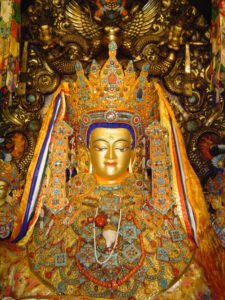
Jowo Statue (Lhasa)
Bumthang Padtselling Jangchub Pelri Monastery
Like the great Bodhisattva Manjushri and Vairocana who lived for the welfare of all sentient beings, the highly accomplished master Namgyal Lhundup went to Lhasa to take a vow before the Jowo statue and started one billion recitation of Phagpa Zangpo Chodpai Monlam for the welfare of all sentient beings. At that time, the Jowo Statue spoke thus.
Son! Don’t be very ambitious
Go instead to the south
East of Kurje Lhakhang in Bumthang is a place
Make it your monastic seat
You will fulfil your dreams
Name it Jangchub Pelri.
East of Kurje Lhakhang, this prophesized place is located atopa ridge and amidst forests where even tree branches bow as if to welcome all visitors. Wild flowers and medicinal herbs are common sight. One particular flower, dongdola blossoms both in summer and winter and fill the whole area with sweet fragrance, like offerings to gods and goddesses. No wonder many birds including cuckoos make it their home and sing in praise of the monastery.
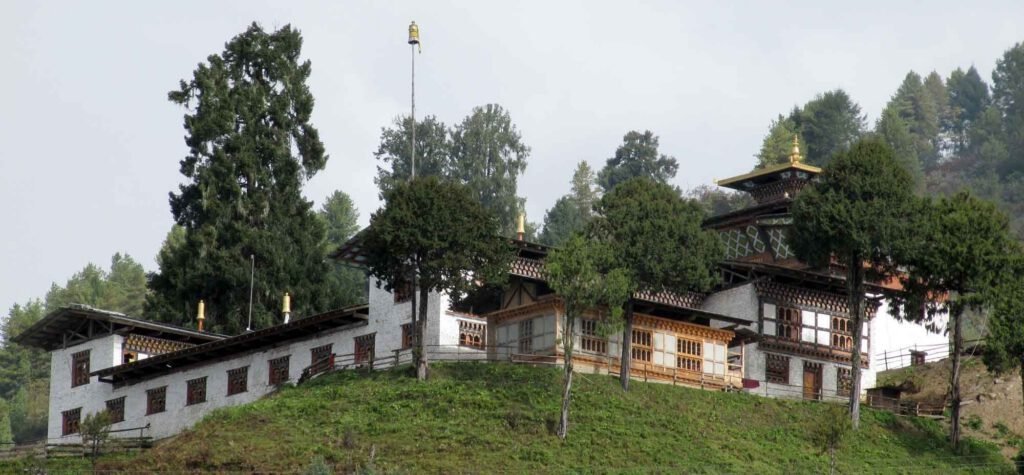
Farther away from the monastery is a place festooned with dratshang (monastic body), meditation centres, and several hermitages. There one can see the faraway mountains like a string of glass stupas and thick forest amidst meadows like the offering of Mandala. There are many streams flowing down the valleys and lakes. The songs of black-necked cranes hovering above inspire persons to spend the whole life pursuing spiritual life, in the quietness of the mountains.
Located at 3250 metres above the sea level, the monastery commands an excellent view of the valley below. In front of the monastery across the Chamkharchu are hakhangs of Jampa, Kurje and Tselung together known as Chokhor Namsum. The Chamkhar town, with the Chamkharchu flowing nearby, is also visible. There is no place like Padtshaling in its sacredness and magnificence.
It is said that the Padtshaling Monastery rests like a heap of jewels on the lap of a ridge resembling Zambalha, the god of wealth. It is 230 kilometres from Thimphu and 1 kilometres from Chamkhar town.
Before the monastery was established by Drupthob Namgyal Lhundup, the place was a pastureland of successive Jakar dzongpons. Since the place is home to several kinds of flowers and especially, dongdola blossom in both summer and winter, it is widely known as Padtshaling (pad tshal ling, the land of flower groove). After the monastery was established, it was named Jangchub Pelri as advised by Lhasa Jowo. But the people prefer to call it by its old name Padtshaling Gonpa and Drupthob’s successive reincarnations are known as the Padtshaling trulkus.
Below the monastery towards the south there are two springs—phochu and mochu-revealed by Drupthob himself. Anyone can cleanse their obscuration by taking a shower in or drinking from these springs. It is also known to ward off any unfortunate events.
Not far from the monastery, towards the east, is a boulder. It is said that when Namgyal Lhundup came to look for a monastic site, tshomen (female water spirit) tried to stop him, but the Drupthob transformed the tshomen into a stone.
Towards the north of the monastery there is another rock bearing the image of a dakini’s breast. Next to the rock is a cave, where the Drupthob once lived and meditated after he was driven away by the Jakar Dzongpon from the present monastery site.
To the west of the monastery is a self-emanated conch shell on a rock and the palace of the local deity, Naydag Marpo Gomchen, who was subdued by Guru Rimpoche. Naydag Marpo lives by the oath he had taken and is considered an enlightened being. Since the monastery overlooks sacred sites in four directions, it is widely known as the Chogzhi Nay. According to the oral tradition, monal pheasants living nearby the monastery belong to the Naydag Marpo. In the past this local deity was said to be even herding the cattle belonging to the monastery.
It is said that when the Drupthob was returning to the monastery from Takar Zhong, the guardian spirits of the area welcomed him by transforming themselves into a tiger and a leopard, whose rock images can be seen some distance below the monastery.
Drupthob Namgyal Lhundup was a real emanation of Palchen Dorji Zhonu and the master of all untamed spirits. He was able to transform visible things into invisible things and vice versa. He had the power to control all fearful spirits.